Understanding Density, Dimensional, and Dynamic Pricing
And how they can directly impact your bottom line
Density Pricing
Widely used since the early 2000s to help carriers offset the cost of transporting inefficient packages through their network.
If you're shipping ping-pong balls, or glassware, this is you
Density Pricing
- Lightweight or bulky shipments cost more to transport
- Costs can increase even if order volume goes up
- Product mix and packaging choices strongly influence these charges
- Often raises spend without obvious operational changes


Dimensional Pricing
Technological advances allowed parcel companies to clearly identify and implement dimensional pricing since 2015
If you ship skis or ladders around the country, you know what I'm talking about
Dimensional Pricing
- Pricing is based on package size, not just weight
- Larger boxes cost more to ship, even if they are light
- Extra or unused space in packaging drives higher charges
- Costs rise as product variety and packaging inconsistency increase
- A common source of unexpected shipping cost increases
Dynamic Pricing
Starting in 2025, advances in Machine Learning and AI allow shipping companies to automatically change pricing depending on their network conditions.
In other words, if the delivery route is popular on that day, or that week, it could cost you more
Dynamic Pricing
- Shipping prices change based on demand and available capacity
- Rates increase during busy periods or when capacity is tight
- Costs are not always fixed, even under contract
- Makes shipping spend harder to predict
- Can quickly impact margins during growth or peak seasons

The Challenge is that with Dynamic Pricing
You Cannot Accurately Forecast Your Shipping Costs
And that, WILL Impact, your Bottom Line
Contract Negotiation
Is no longer the best solution
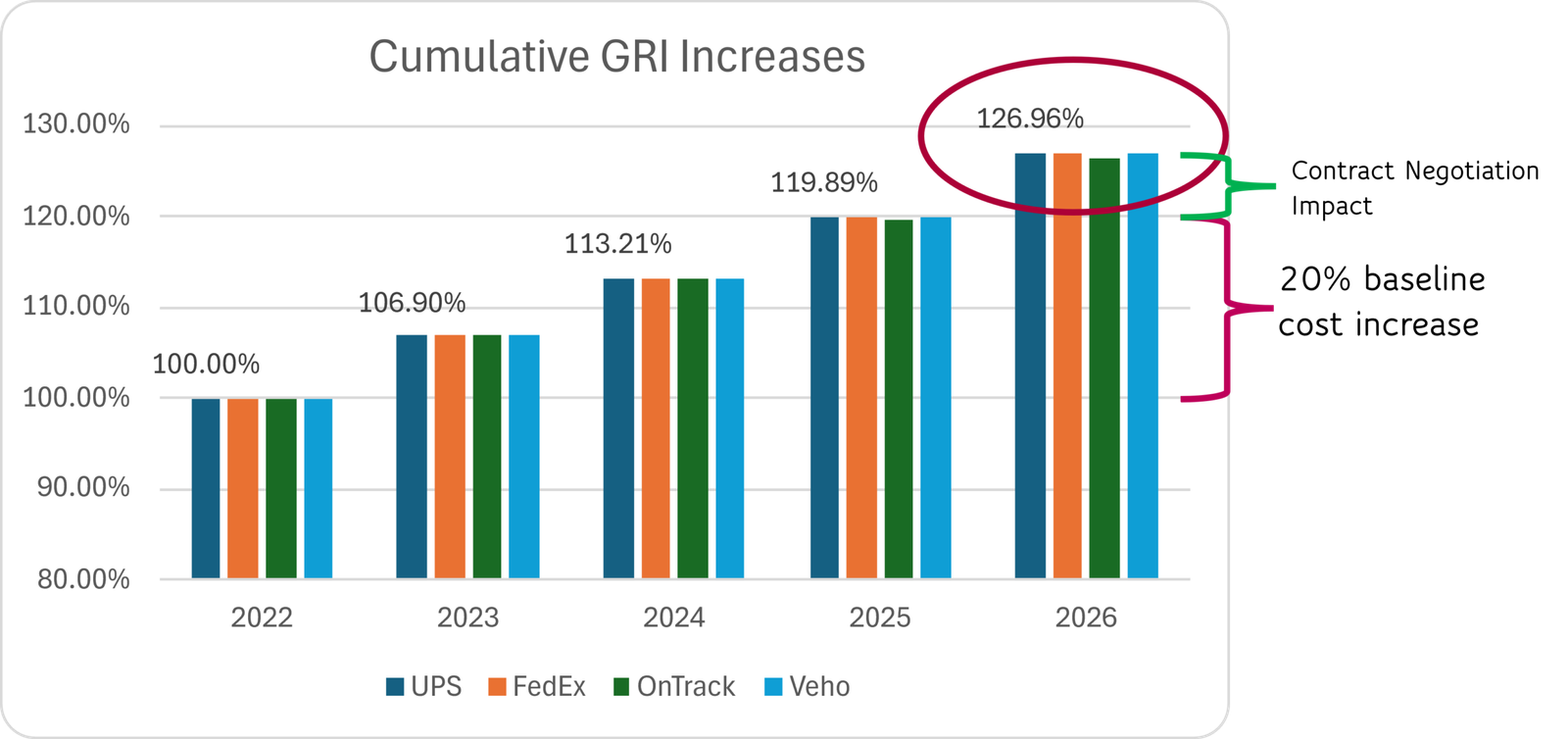
Parcel companies have increased their prices through GRIs almost 25% in the last four years.
Contract negotiation only potentially addresses the most recent cost, but does nothing to the almost 20% accumulated baseline.
- Pricing is no longer fully fixed by contract. Carriers now use dynamic and rule-based pricing that can change based on volume patterns, capacity, and network conditions, even within a contract period.
- Cost drivers sit outside traditional rate tables. Dimensional, density, and surcharge mechanics often outweigh negotiated base rates and discounts.
- Carriers optimize continuously, shippers negotiate periodically. Parcel companies adjust pricing models year-round, while most contracts are locked in annually.
- Growth can increase costs instead of lowering them. Higher volume does not always lead to better economics when shipment profiles reduce carrier efficiency.